
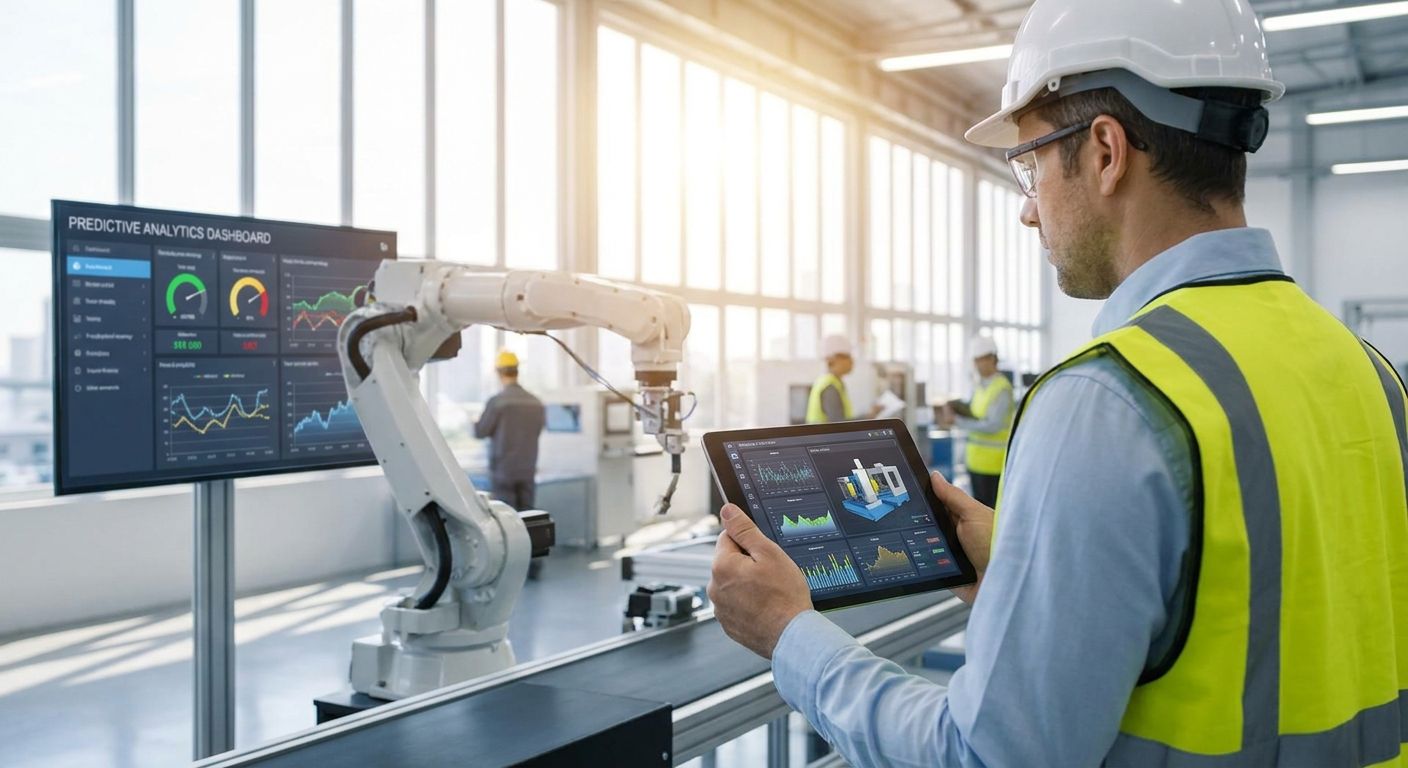
Manufacturers shortlisting predictive analytics tools for manufacturing in 2026 are narrowing the field to eight platforms: C3 AI, SAP Analytics Cloud, IBM Maximo Application Suite, PTC ThingWorx, AWS SageMaker with Lookout for Equipment, Microsoft Azure IoT plus Synapse, Seeq, and Uptake. Best overall: C3 AI for multi-plant enterprise rollouts. Best for SAP-standardized manufacturers: SAP Analytics Cloud. Best for pure predictive maintenance: IBM Maximo Application Suite.
- C3 AI wins for multi-plant predictive analytics tools for manufacturing at enterprise scale in 2026.
- SAP Analytics Cloud fits manufacturers already running SAP ERP and MES modules.
- IBM Maximo Application Suite leads pure predictive maintenance for asset-heavy plants.
- PTC ThingWorx and Seeq specialize in IIoT condition monitoring and process analytics.
- None of these platforms deploy themselves - integration determines whether the ROI shows up.
Why this matters
Predictive analytics tools for manufacturing don't compete on algorithms anymore. Every platform on this list can run a regression or a classification model on sensor data. They compete on how fast they connect to your existing ERP, MES, and SCADA systems, and on whether the output a maintenance technician sees is a clear failure-risk score or an unreadable probability curve.
Fortiv Solutions integrates predictive analytics platforms into live manufacturing environments, and the pattern repeats: the platform choice matters less than the data pipeline feeding it. A manufacturer running clean sensor history for 18 months of production sees results from a mid-tier platform faster than a manufacturer running a top-tier platform on six weeks of patchy data.
This guide ranks eight platforms on integration depth, deployment flexibility, and real deployment complexity, not marketing claims.
What makes the best predictive analytics tool for manufacturing
- Integration depth with existing ERP, MES, and SCADA systems, not a bolt-on data export
- Time-series and sensor data handling at production-floor scale, across dozens or hundreds of assets
- Explainable model outputs maintenance teams can act on, not black-box probability scores
- Deployment flexibility across cloud, on-premises, and edge devices for plants that can't route everything through the internet
- Vendor support for model retraining as production lines, equipment, and failure modes change
- Verified deployment history in asset-heavy or process manufacturing, not just pilot projects
Predictive analytics tools for manufacturing: at a glance
| Platform | Best For | Standout Feature | Key Limitation |
|---|---|---|---|
| C3 AI | Enterprise-scale, multi-plant predictive analytics | Pre-built AI models for asset reliability across industries | Full value typically requires a systems integrator |
| SAP Analytics Cloud | SAP-standardized manufacturers | Native connection to SAP ERP, PM, and MES data | Weaker fit outside the SAP ecosystem |
| IBM Maximo Application Suite | Asset-heavy predictive maintenance | Combines asset management with Watson-based failure prediction | Complexity rises fast outside IBM's own stack |
| PTC ThingWorx | IIoT-driven condition monitoring | Broad sensor and legacy-device connectivity via Kepware | Deep predictive analytics need add-on modules |
| AWS SageMaker + Lookout for Equipment | Custom ML builds on cloud infrastructure | Managed anomaly detection trained on your own sensor data | Needs in-house or partner data science capability |
| Microsoft Azure IoT + Synapse + Azure ML | Microsoft-stack enterprises | Single pane across ingestion, storage, and modeling | Value depends on already licensing Microsoft's stack |
| Seeq | Continuous and process manufacturing | Reads directly from existing process historians | Less suited to discrete, unit-based manufacturing |
| Uptake | Standalone industrial asset performance management | Narrow focus speeds up time-to-value for predictive maintenance | Doesn't cover broader operational analytics |
1. C3 AI: best overall for enterprise-scale predictive analytics
C3 AI runs a model-driven enterprise AI platform with pre-built applications for asset reliability, inventory optimization, and predictive maintenance, built to operate across dozens or hundreds of manufacturing sites from a single deployment.
C3 AI pros:
- Pre-built industry models cut the custom data science work needed to reach a first production model
- Handles multi-plant, multi-asset-class deployments without rebuilding the platform per site
- Established deployment history in heavy industry and process manufacturing
C3 AI cons:
- Full value typically requires a systems integrator familiar with the platform's architecture, not a self-serve license
- Single-plant manufacturers may find the enterprise scope heavier than what they need
Best for: manufacturers running predictive analytics across multiple plants who want one platform instead of a patchwork of point tools.
Verdict: Buy for multi-site manufacturers standardizing predictive analytics in 2026.
2. SAP Analytics Cloud: best for SAP-standardized manufacturers
SAP Analytics Cloud extends predictive analytics directly into ERP, plant maintenance, and manufacturing execution data already sitting inside an SAP environment.
SAP Analytics Cloud pros:
- Native integration with SAP ERP and PM modules avoids building a separate data pipeline
- Familiar interface for teams already trained on SAP tools
- Strong fit for finance-linked predictive use cases like spare-parts inventory and maintenance budgeting
SAP Analytics Cloud cons:
- Manufacturers running non-SAP shop-floor systems face more integration work to bring sensor data in
- Predictive modeling depth lags AI-native platforms on complex, multi-variable failure modes
Best for: manufacturers already standardized on SAP ERP who want predictive maintenance without adding a second core system.
Verdict: Buy if SAP is already the system of record; Skip if it isn't.
3. IBM Maximo Application Suite: best for asset-heavy predictive maintenance
Maximo combines enterprise asset management with Watson-based predictive maintenance, scoring equipment failure risk from maintenance history, sensor readings, and inspection data.
IBM Maximo pros:
- Asset management and predictive maintenance live in one system, cutting double data entry
- Strong track record in utilities, oil and gas, and heavy manufacturing
- Mobile inspection and work-order tooling built in
IBM Maximo cons:
- Deployment complexity increases once manufacturers extend Maximo outside IBM's own ecosystem
- Predictive models need clean historical maintenance data; sparse records slow time-to-value
Best for: manufacturers running formal asset management programs who want predictive maintenance built into the workflow.
Verdict: Buy for asset-heavy plants with mature maintenance data.
4. PTC ThingWorx: best for IIoT-driven condition monitoring
ThingWorx connects shop-floor sensors, PLCs, and legacy equipment through Kepware into a single IIoT layer, then layers condition monitoring and anomaly alerts on top.
PTC ThingWorx pros:
- Broad device and protocol support makes connecting older machinery easier
- Strong visualization tools built for plant managers, not data scientists
- Modular setup lets manufacturers start with monitoring and add predictive modules later
PTC ThingWorx cons:
- Deep predictive analytics require add-on modules rather than shipping out-of-the-box
- Model accuracy depends heavily on sensor coverage across the line
Best for: manufacturers digitizing older equipment who need connectivity and monitoring before full predictive modeling.
Verdict: Hold - start here if sensor coverage is still incomplete.
5. AWS SageMaker + Lookout for Equipment: best for custom ML builds
AWS pairs SageMaker's general machine learning tooling with Lookout for Equipment, a managed anomaly-detection service trained on a manufacturer's own historical sensor data.
AWS pros:
- Flexibility to build custom models for failure modes off-the-shelf platforms don't cover
- Pay-as-you-go cloud infrastructure avoids large upfront hardware spend
- Integrates with the broader AWS IoT stack for manufacturers already on AWS
AWS cons:
- Requires in-house or partner data science capability; this is a toolkit, not a finished application
- Time-to-first-model runs longer than pre-built platforms like C3 AI or Maximo
Best for: manufacturers with a data science team or implementation partner who want a custom-built predictive model.
Verdict: Buy for teams ready to build, not just license.
6. Microsoft Azure IoT + Synapse + Azure ML: best for Microsoft-stack enterprises
Azure's stack pulls sensor and MES data through Azure IoT, stores and processes it in Synapse, and builds predictive models in Azure Machine Learning inside one tenant.
Azure pros:
- Single governance and security model across ingestion, storage, and modeling
- Strong fit for manufacturers already licensing Microsoft 365, Dynamics, or Power Platform
- Power BI integration makes predictive outputs visible to non-technical plant staff
Azure cons:
- The cost and complexity advantage largely disappears for manufacturers not already on Microsoft's stack
- Assembling ingestion, storage, and modeling still takes integration work
Best for: manufacturers already standardized on Microsoft's enterprise stack.
Verdict: Buy if Microsoft is already the default vendor.
7. Seeq: best for continuous and process manufacturing
Seeq is purpose-built for time-series analytics in continuous and batch process manufacturing - chemicals, pharma, food and beverage - connecting to existing historian systems rather than replacing them.
Seeq pros:
- Reads directly from process historians without a separate data lake
- Process engineers can build models without deep data science training
- Strong for root-cause and batch-to-batch variability analysis
Seeq cons:
- Narrower fit for discrete, unit-based manufacturing than continuous process plants
- Predictive maintenance on individual machine assets isn't the core use case
Best for: process manufacturers who need analytics on top of an existing historian.
Verdict: Buy for continuous-process plants; Skip for discrete assembly lines.
8. Uptake: best for standalone industrial asset performance management
Uptake focuses exclusively on industrial asset performance management, scoring failure risk on rotating equipment, fleets, and heavy machinery.
Uptake pros:
- Narrow focus means faster time-to-value for pure predictive maintenance use cases
- Strong track record with heavy equipment and industrial fleets
- Simpler to evaluate than multi-purpose analytics platforms
Uptake cons:
- Doesn't cover broader operational analytics like quality, throughput, or inventory
- Smaller integration ecosystem than AWS, Azure, or SAP
Best for: manufacturers who want predictive maintenance and nothing else.
Verdict: Hold - evaluate against multi-purpose platforms before committing.
How we ranked
These eight predictive analytics tools for manufacturing are ranked against the criteria above: integration depth with existing ERP, MES, and SCADA systems, sensor data handling at production scale, explainability of model outputs, deployment flexibility, and vendor support for retraining models as production lines change.
Fortiv Solutions integrates these platforms into live SAP, MES, and SCADA environments for manufacturing clients, and that's where the gap between a platform's sales deck and its real deployment timeline shows up. For a broader view of AI systems built for shop-floor operations, see the AI for manufacturing software comparison. Manufacturers evaluating implementation partners rather than platforms alone can review AI consulting companies in India.
Which predictive analytics tool should you choose in 2026?
Pick C3 AI if you're standardizing predictive analytics across more than one plant and need an enterprise platform built for that scale. Pick SAP Analytics Cloud if SAP ERP is already your system of record and you don't want a second core platform for maintenance data. Pick IBM Maximo Application Suite if your maintenance program is mature enough to run on failure-risk scoring, not just condition monitoring.
Manufacturers still assembling sensor coverage should start with PTC ThingWorx or a managed anomaly-detection service like AWS Lookout for Equipment before committing to a full predictive maintenance program. The platform matters less than the state of your data going in - a predictive analytics license on top of unreliable sensor feeds and disconnected MES data produces dashboards nobody trusts in 2026, the same way it did in earlier deployment cycles.
Plan your predictive analytics rollout
Fortiv Solutions integrates predictive analytics platforms into live manufacturing environments.
FAQ
What's the best predictive analytics tool for manufacturing in 2026?
C3 AI is the best overall predictive analytics tool for manufacturing in 2026 for multi-plant, enterprise-scale deployments. SAP Analytics Cloud wins for SAP-standardized manufacturers, and IBM Maximo Application Suite wins for asset-heavy predictive maintenance programs.
Is C3 AI better than IBM Maximo for predictive maintenance?
C3 AI is built for broader, multi-plant predictive analytics across asset classes, while IBM Maximo Application Suite is built specifically for asset management combined with predictive maintenance. Maximo fits manufacturers with mature maintenance programs; C3 AI fits manufacturers standardizing analytics across sites.
Do predictive analytics tools work with legacy SCADA and MES systems?
Most enterprise predictive analytics platforms connect to legacy SCADA and MES systems through middleware like Kepware or custom API integrations. Connectivity depth varies by platform, which is why integration support is one of the ranking criteria in this guide.
How long does it take to deploy predictive analytics on a factory floor?
Deployment timelines depend on existing sensor coverage and data quality more than on the platform chosen. Manufacturers with clean historical failure data move to a working model faster than manufacturers still building out sensor infrastructure.
Can predictive analytics tools work without full IoT sensor coverage?
Partial sensor coverage limits which assets a model can score, but platforms like PTC ThingWorx and AWS Lookout for Equipment let manufacturers start with the sensors they have and expand. Full predictive maintenance programs need broader coverage over time.
What's the difference between predictive maintenance and predictive analytics in manufacturing?
Predictive maintenance is a specific use case: forecasting equipment failure before it happens. Predictive analytics for manufacturing is the broader category, covering maintenance, quality, demand, and inventory forecasting on the same underlying platforms.
Should manufacturers build predictive analytics in-house or buy a platform?
Manufacturers with an internal data science team can build on toolkits like AWS SageMaker; most others reach production faster on pre-built platforms like C3 AI or IBM Maximo. The decision depends on internal capability, not platform price.
How does Fortiv Solutions help manufacturers implement predictive analytics?
Fortiv Solutions designs and integrates predictive analytics systems into existing SAP, MES, and SCADA environments for manufacturing clients, connecting the chosen platform to live production data rather than leaving it as a standalone pilot.
One last thing
Predictive analytics tools for manufacturing don't fail on the algorithm - they fail on missing failure history. A platform that's never seen a specific bearing or motor fail on your line has no pattern to detect. Clean sensor and maintenance data going back at least a year matters more in 2026 than which vendor's name is on the license.